
If you’ve heard that the number of homes for sale isn’t growing as quickly as it was, that’s true. But it doesn’t mean buyers are suddenly running out of options.
Inventory growth has slowed considerably, but homes are still being added to the market. And here in the Midwest, the inventory picture is actually stronger than the national headlines may suggest.
Inventory Growth Has Slowed—Not Stopped
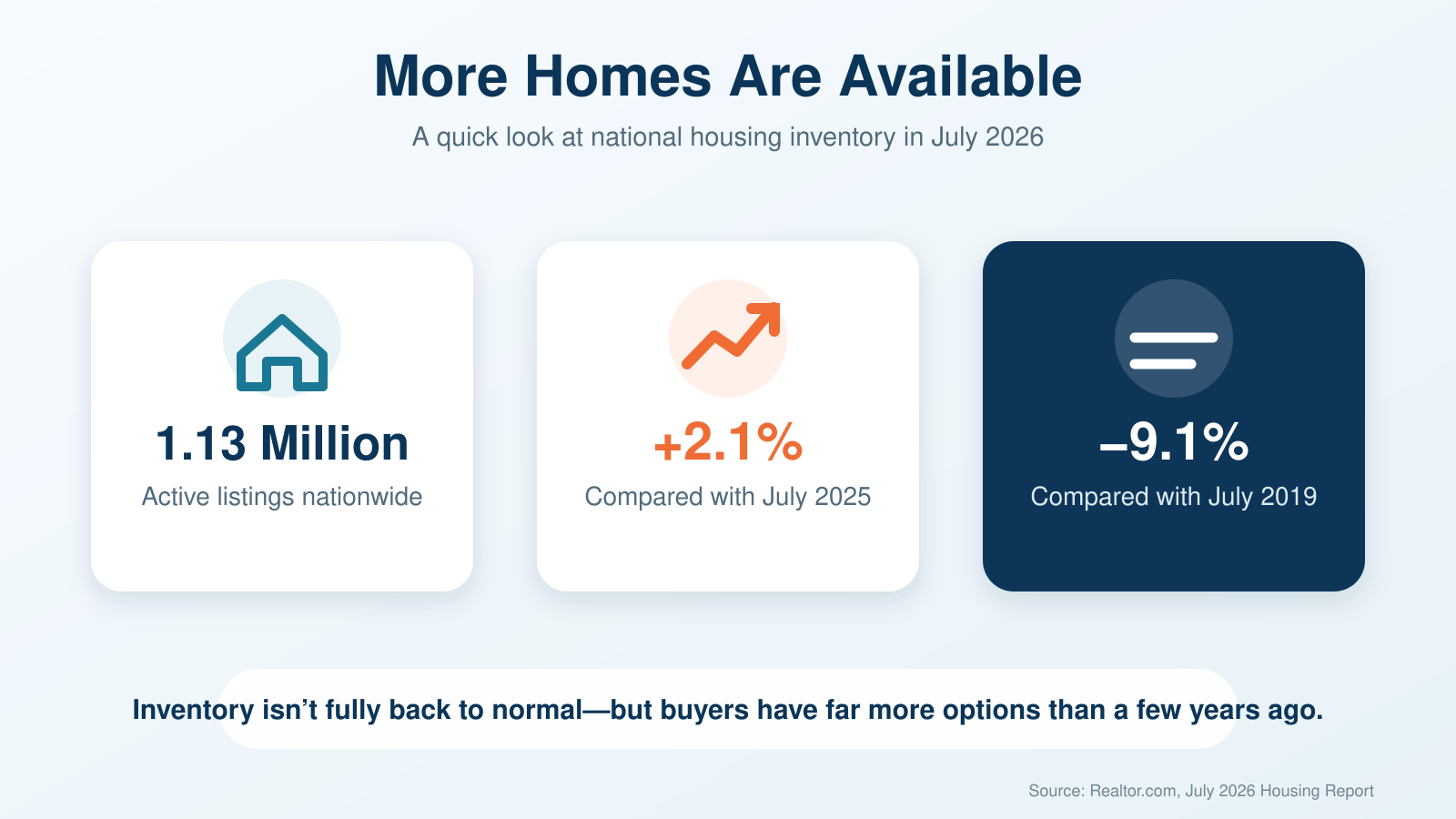
According to Realtor.com’s July 2026 housing report, the number of active listings increased 2.1% compared with both June and July of last year.
That’s a much slower annual increase than we saw earlier in the housing-market recovery. But the important thing to remember is that inventory is still growing.
Nationally, there were approximately 1.13 million active listings in July. That gave buyers more choices than they had a year ago—even if the improvement wasn’t as dramatic as it had been in previous months.
Inventory growth has also remained fairly steady recently. That may be a sign the slowdown is beginning to stabilize rather than heading toward a major decline.
.png)
The Midwest Is Outperforming the National Market
Real estate is always local, and this is where the national numbers can be misleading.
While active inventory increased 2.1% nationwide in July, the Midwest posted a much stronger 9.3% year-over-year increase. New listings in the Midwest also rose 3.2% compared with last year.
That doesn’t mean every neighborhood in Kane County, DuPage County, or the Fox Valley suddenly has plenty of inventory. Certain communities, property types, and price ranges remain competitive.
But overall, buyers in our area may have more opportunities than the national numbers alone would suggest.
Inventory Has Come a Long Way Since 2021
Today’s market looks very different from the severe housing shortage buyers faced a few years ago.
Active inventory has now increased year over year consistently since November 2023. Realtor.com also reported that the market remained above 1.1 million active listings for several consecutive weeks this summer—a level not sustained since 2019.
National inventory is still below pre-pandemic norms, but the gap has narrowed considerably. July’s active-listing count was approximately 9% below July 2019, according to Realtor.com.
We aren’t completely back to normal, but we’re much closer than we were during the low-inventory years of 2021 and 2022.
How Mortgage Rates Affect the Number of Homes for Sale
Mortgage rates play a complicated role in housing inventory.
When rates stay elevated, some buyers step back or take longer to make a decision. Homes may remain available longer, allowing the total number of active listings to build. That can give the buyers who remain in the market more time and negotiating room.
Higher rates can also discourage some homeowners from selling because they don’t want to give up the low mortgage rate on their current home. So, higher rates don’t automatically mean a rush of new listings.
The real effect comes from the balance between new homes entering the market and how quickly buyers purchase them.
Realtor.com currently forecasts mortgage rates to average approximately 6.3% in 2026 and projects the number of existing homes for sale to finish the year 3.6% higher than in 2025. View Realtor.com’s updated 2026 forecast.
What More Inventory Means for Buyers
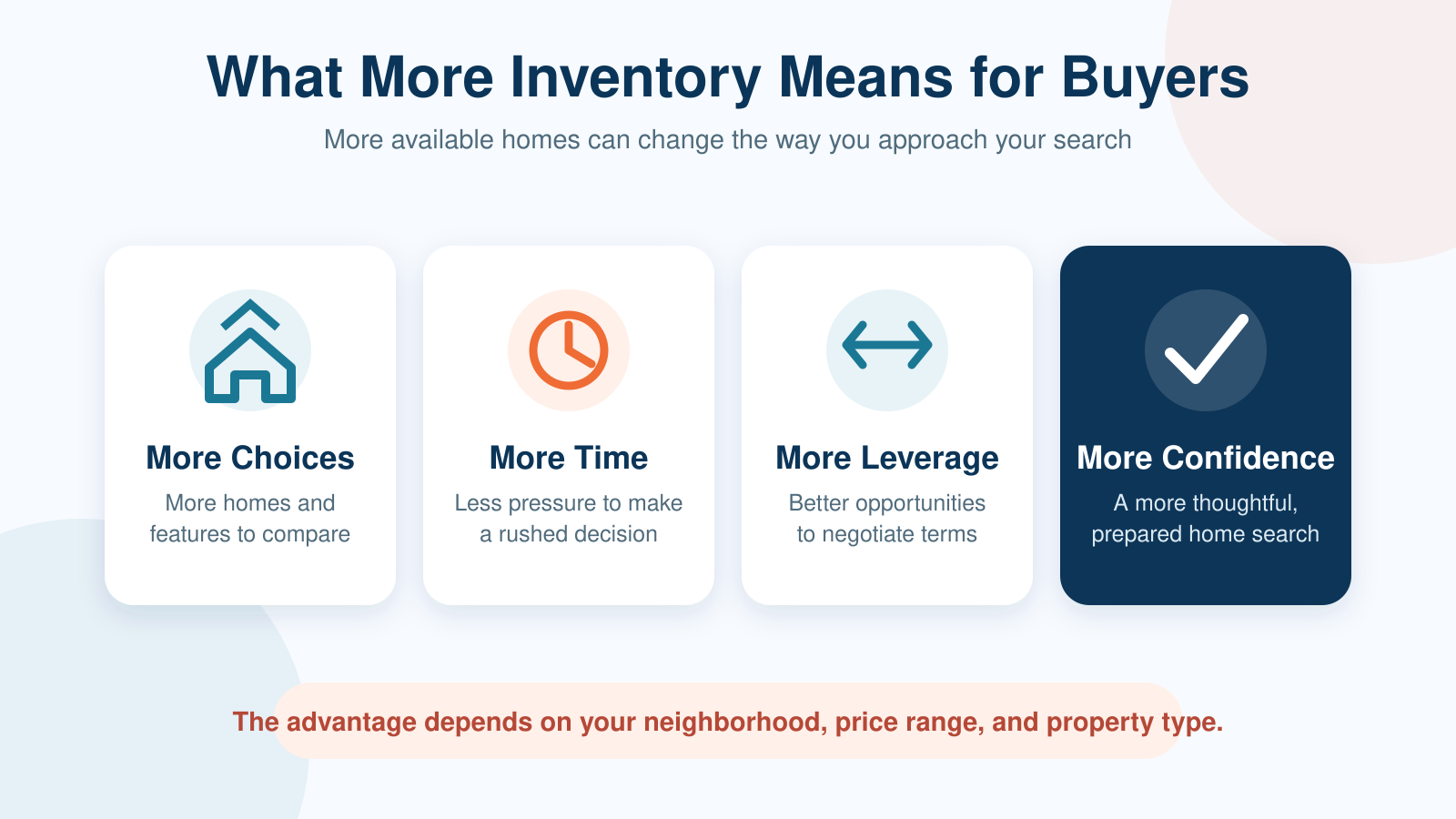
When more homes remain on the market, buyers may benefit from:
- More properties to compare
- More time to make a thoughtful decision
- Less pressure to waive important protections
- Greater potential to negotiate on price
- Better opportunities to request closing-cost credits or repairs
That doesn’t mean every home will be negotiable. A well-priced property in a desirable area can still attract multiple offers.
But compared with the market a few years ago, many buyers now have more breathing room.
Don’t Let National Headlines Determine Your Strategy
A national inventory report can help explain the overall direction of the market, but it can’t tell you how many homes are available in St. Charles, Geneva, Batavia, South Elgin, or another specific community.
Even within the same town, conditions can change based on the price range, property type, school district, and neighborhood.
That’s why the best approach is to look at the actual competition in the areas where you want to buy—not assume the national market applies equally everywhere.
Bottom Line
Inventory growth has slowed, but it hasn’t stopped. Nationally, buyers had more homes to choose from in July than they did a year earlier, and inventory growth in the Midwest was considerably stronger than the national average.
If you’re thinking about buying in Kane County, DuPage County, or the Fox Valley, you may have more options—and more negotiating room—than you realize. Let’s look at what’s currently available and build a strategy around the market you’re actually shopping in.
August 19, 2026